Skip to content

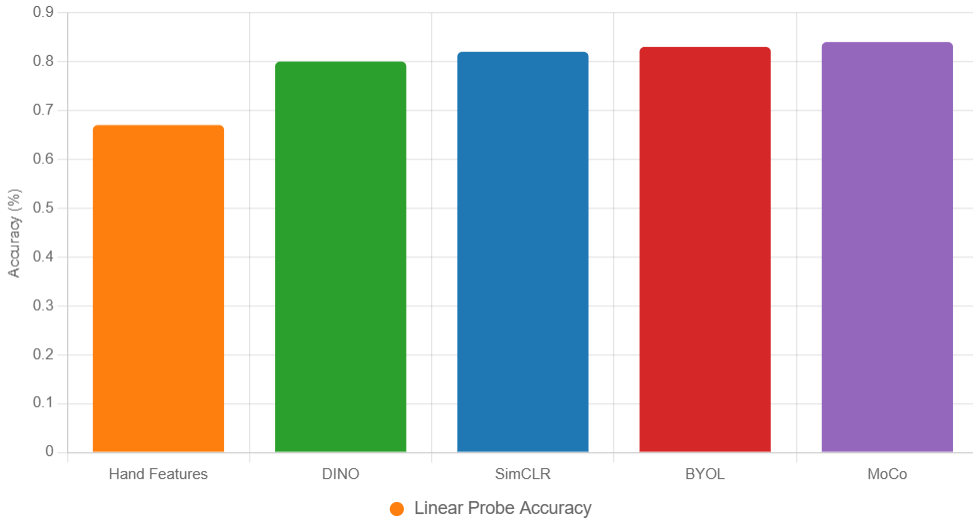
DINO v2 for Self-Supervised RF Representations

Critique and Proposal for BYOL Adaptation to RF Signals Building on your work across “RL-Driven RF Neuromodulation,” “Hybrid Super-Voxel Segmentation,” “Structured Gradients for Neuro–Saliency Under RF Stimulation,” and “DINO v2 for Self-Supervised RF Representations,” adapting… 

Structured Gradients for Neuro–Saliency Under RF Stimulation

Saliency maps derived from input gradients are popular for visualizing and controlling model responses [1,2, 3]. In RF neuromodulation or analogous control settings, however, raw gradients often exhibit speckled,high-frequency artifacts that are hard to actuate.… 

Pattern Recognition with Fuzzy Objective Function Algorithms

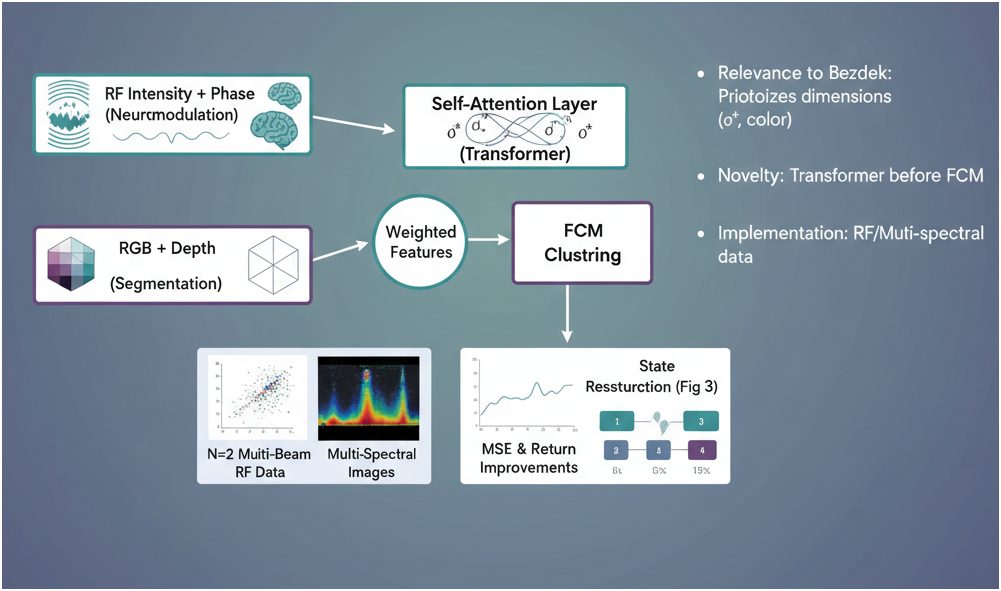
The reference ‘@book{Bezdek1981FCM, title = {Pattern Recognition with Fuzzy Objective Function Algorithms}, author = {James C. Bezdek}, year = {1981}, publisher = {Springer}}’ is highly relevant to your paper “Hybrid Super-Voxel Segmentation: Graph Cuts +… 

Intel CSI Tool vs Nexmon for Neural RF Sensing

We present a controlled bake-off betweentwo widely used Wi-Fi CSI capture stacks—the IntelCSI Tool and Nexmon—for neural RF sensing. Wecompare subcarrier resolution, signal stability, andsetup cost, and offer platform guidance grounded inreproducible scripts and auto-press… 

CSI→Voxel: Wi-Fi Sensing as a Low-Cost fMRI Proxy

Functional magnetic resonance imaging (fMRI) provideshigh-resolution, voxel-wise measurements of brain activity, butacquiring large-scale fMRI datasets is expensive, immobile,and time-consuming. At the same time, commodity wirelessdevices continually capture channel state information (CSI)— a rich, multi-dimensional signal… 

RL-Driven RF Neuromodulation

🧠 Reinforcement Learning Takes the Wheel: A Smarter Approach to RF Neuromodulation Neuromodulation—using techniques like radiofrequency (RF) energy to precisely tune brain activity—holds immense promise for treating neurological conditions. However, achieving effective and safe closed-loop… 

Multi-Source Context Fusion for SIGINT: Marrying SDR Streams with Astrophysical (JWST), Orbital (ISS), and HEP (LHC) Telemetry to Enrich Classification

We study multi-source context fusion for signal classification from software-defined radio (SDR) streams. We exploreenriching SDR features with contemporaneous, public-domaintelemetry from astrophysical (e.g., observatory scheduling andenvironment), orbital (e.g., satellite attitude/visibility windows),and high-energy physics (e.g., collider…