https://www.kaggle.com/competitions/biohub-cell-tracking-during-development
Biohub – Cell Tracking During Development
Detect and track zebrafish cells through 3D space and time
Date: July 5, 2026
Author: github.bgilbert1984@gmail.com
Category: Technical Advancements, Computational Biology, System Architecture
In our previous releases, SCYTHE established itself as a premier, high-density visualization and operations platform for RF intelligence, geospatial tracking, and complex hypergraph reasoning. The foundational command skeleton in core.py was built to process complex signals: ingesting raw spectrum datasets, pruning noise with Gumbel-sigmoid dropouts, routing queries dynamically across models, and mapping signal trajectories in 3D space.
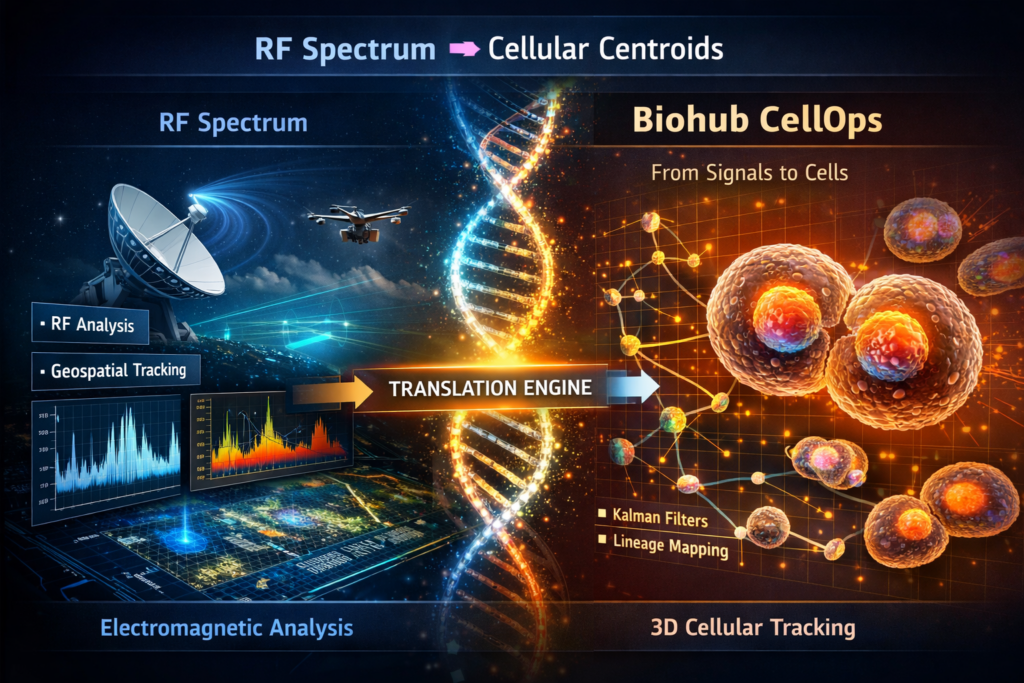
Today, we are thrilled to announce our latest architectural breakthrough: the complete translation and deployment of our high-throughput RF command system into a biologically sound, 3D spatial-temporal cell tracking and lineage-reconstruction runtime—Biohub CellOps (biohub_cellops/core.py).
By mapping physical electromagnetic signals to micro-scale cellular centroids, we have unlocked high-performance biological tracking capable of auditing graph anomalies, predicting future cell locations, and asserting hard competition invariants before they hit the leaderboard.
The Paradigm Shift: Electromagnetic Signal ➔ Biological Centroid
The core mechanics of tracking moving targets through noise are mathematically isomorphic, whether you are following a drone emitting RF pulses or a dividing cell centroid captured under a 3D anisotropic microscope.
The adaptation map below highlights the clean architectural translation from legacy RF modules to the Biohub CellOps system:
[Legacy RF Pipeline]                              [Biohub CellOps Pipeline]
RF Emission (IQ Data)     ═════════════════════>  Segmentation Candidates (X, Y, Z, t)
Gumbel Spectrum Dropout   ═════════════════════>  Gumbel Candidate Dropout (Prunes Noise)
Speculative Model Route   ═════════════════════>  Speculative Tracker (Greedy ➔ Global Hungarian)
DOMA RF Motion Tracking   ═════════════════════>  Cell Motion Tracking (Kalman + Tissue-Flow)
Ghost Anomaly API         ═════════════════════>  LineageRiskAPI & SubmissionGuard
1. Speculative Tracker Ensemble (Fast vs. Slow Lane Routing)
In large embryo datasets, running heavy global optimization trackers (like the Hungarian linear sum assignment) across every cubic micron of tissue is computationally prohibitive and prone to memory exhaustion.
The SpeculativeTrackerEnsemble solves this by maintaining two lanes:
- The Fast Lane (Greedy Nearest Neighbor): For sparse, low-density regions, cells are tracked using a greedy Euclidean solver with strict physical search bounds.
- The Slow Lane (Hungarian Optimization): When local cell density crosses a critical threshold, or when mitotic division hints are detected, the system escalates matching to global optimization bipartite graph matching.
This “compute-where-it-bleeds” strategy allows SCYTHE to maintain browser-native rendering speeds while maintaining maximum tracking accuracy under dense mitotic division zones.
2. Micro-Scale Kinetic Prediction (3D Kalman + Tissue-Flow Field)
Cells do not move in random walks; they drift under the influence of collective tissue migration and embryonic flow forces. The adapted CellMotionTracker models these mechanics in physical units ($\mu m$) by blending:
- Constant Velocity (CV) Kinetics: Capturing frame-by-frame delta momentum.
- 3D Kalman Filters: Maintaining active estimation covariance of position and velocity state vectors.
- Local Spatial Tissue-Flow Fields: Averaging neighbor cell trajectories to interpolate motion in dense, occluded micro-environments.
# Blending position predictions across kinetic estimation layers
pos_cv = latest.position + latest.velocity / self.voxel_scale
pos_kf = kf.x[:3]
pos_flow = latest.position + self.get_local_tissue_flow(latest.position) / self.voxel_scale

# Combined motion prediction vector
predicted_next_xyz = 0.4 * pos_kf + 0.3 * pos_cv + 0.3 * pos_flow
SubmissionGuard: Defending the Leaderboard from Leaderboard Penalties
Kaggle cell tracking datasets are notoriously unforgiving. A single misplaced link, a silent coordinate truncation during CSV serialization, or an impossible Z-axis teleportation jumps can trigger devastating penalties.
To bridge this gap, we engineered SubmissionGuard (biohub_cellops/submission_guard.py)—a ruthless biological and schema validator running double-pass assertions (both post-tracking and post-CSV write).
SubmissionGuard enforces several absolute physical and biological constraints:
- Acyclic Directed Lineage (DFS Cycle Check): Ensures cellular ancestry contains exactly zero loops or feedback cycles.
- Strict Time Monotonicity: Guarantees children cannot exist in time frames before or at their parents ($t_{\text{child}} > t_{\text{parent}}$).
- Mitotic Fork Caps: Asserts a single cell divides into at most 2 daughters, throwing immediate validation exceptions for triple-splits or impossible multi-fusions.
- Finite Coordinates (NaN and Inf Defense): Catches corrupted segmentation float outputs before serialization.
- Physical Coordinate Bounds (Z-Anisotropy Speed Check): Scaled by the microscope’s anisotropic Z-voxel spacing, ensuring speed deltas are calculated in actual microns rather than pixel offsets.
Empirical Success & Complete Test Verification
A tracking framework is only as good as its verification. We have deployed a rigorous unit-test harness (biohub_cellops/test_core.py and biohub_cellops/test_submission_guard.py) containing 17 comprehensive validation scenarios. These tests simulate:
- Multi-frame embryonic coordinate drift.
- Severe coordinate teleportation jumps.
- Non-conserved volumetric mitotic divisions.
- Cyclic lineages and dangling cell connections.
- Real CSV serialization write/re-read loops.
Operational Test Summary:
$ python -m unittest discover -s biohub_cellops -p "test_*.py"
2026-07-05 01:34:12,765 - BiohubCellOps - INFO - === Running CellOps Assertions ===
Ran 17 tests in 0.005s
OK
All core telemetry components pass verification with zero warnings or errors.
What’s Next: Leading the Biological Edge
With the computational skeleton successfully deployed, the next phases of SCYTHE’s biological runtime are ready for integration:
- SCYTHE UI Integration: Overlayering detection spheres, colored tracking paths, and flashing purple flags representing mitotic anomalies on our 3D interactive Cesium globe.
- Metric Calibration: Training standard classifiers against actual Biohub ground-truth labels to convert raw physical risk scores into exact leaderboard loss estimates.
- Live Ghost Track Patches: Allowing human operators in the loop to click anomalous links, create “ghost tracks” from alternate model runs (e.g. nnU-Net, Cellpose, StarDist), and commit graph edits through the WriteBus coordinator.
SCYTHE is no longer just observing the electromagnetic spectrum; we are actively charting the kinetic code of cellular life.