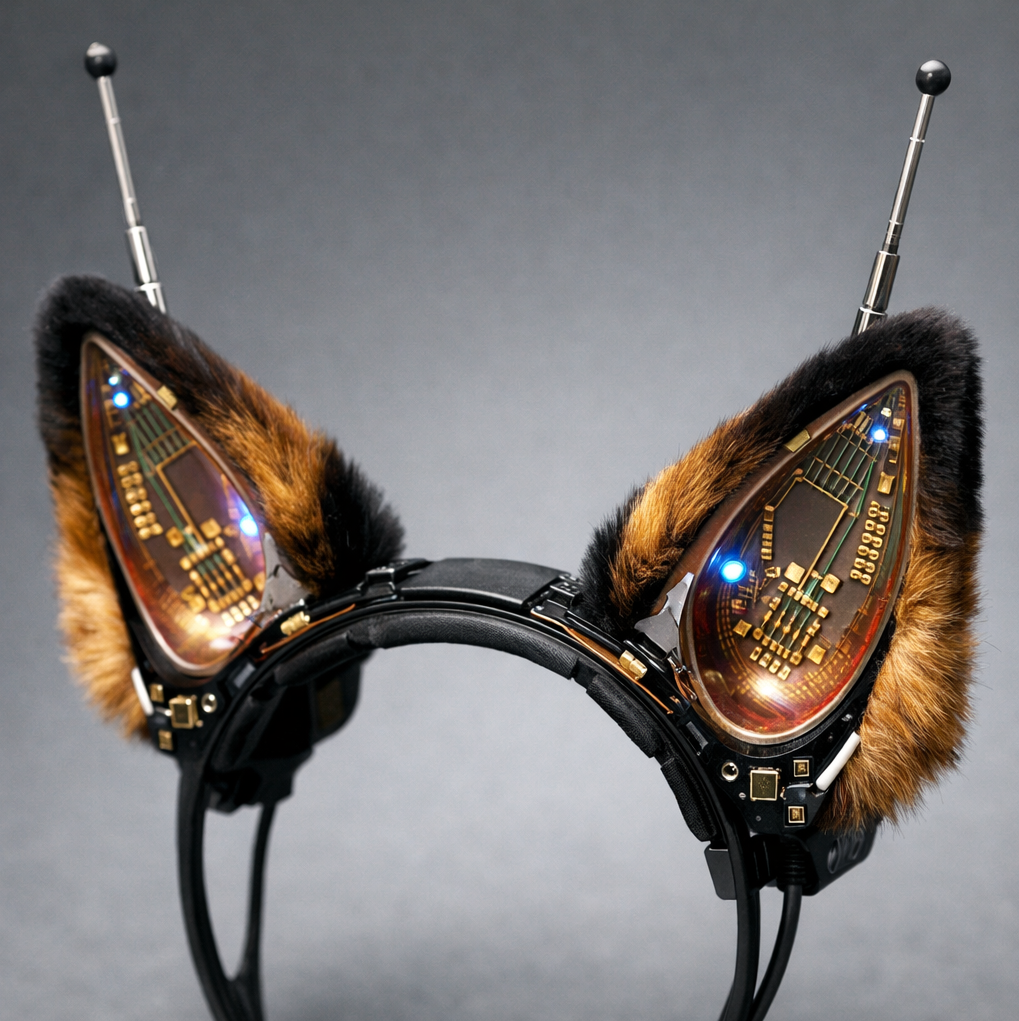
Bio-inspired antenna designs are absolutely viable and, in fact, represent a cutting-edge area of research in wireless communications. By mimicking structural solutions from nature—such as the fractal geometry found in leaves, the hearing mechanisms of insects, or the structural efficiency of animal ears—engineers can create antennas that are more compact, possess broader bandwidths, and offer better performance than traditional rigid, Euclidean-geometry antennas.
Enhancing Your Cybernetic Ear Design
To evolve the design of these cybernetic ears from a primarily aesthetic or prop-based concept into a high-performance functional antenna array, you can focus on the following enhancements:
- Fractal Geometries for Miniaturization: Instead of using standard flat circuit boards for the “ear” internals, integrate fractal patterns (like Koch snowflakes or Sierpinski carpets) into the conductive traces. This increases the effective electrical perimeter within a constrained physical area, allowing the antenna to resonate at lower frequencies (larger wavelengths) while remaining physically small.
- Active Tuning and Reconfigurability: Incorporate MEMS (Micro-Electro-Mechanical Systems) switches or varactor diodes onto the PCB traces. This would allow the antenna to electronically “tune” itself to different frequencies in real-time, effectively changing its impedance and radiation pattern on the fly based on the required communication protocol (e.g., switching between Wi-Fi, Bluetooth, or sub-6GHz 5G bands).
- Defected Ground Structure (DGS): Introduce strategically placed slots or etchings in the ground plane underneath the antenna elements. This technique, often used in professional bio-inspired designs, suppresses unwanted surface currents and mutual interference between the two ears, significantly improving gain and radiation efficiency.
- Flexible Substrates for Wearability: The current design appears rigid. Moving to flexible, high-frequency laminates (such as polyimide-based substrates) would allow the ears to conform slightly better to a user’s head, improving comfort and reducing potential signal decoupling caused by physical misalignment.
- Dielectric Loading:Nature often uses material composition to manage energy. You can apply high-dielectric constant materials over the antenna elements. This “dielectric loading” effectively slows down the electromagnetic waves, further shrinking the required physical size of the antenna for a given frequency.
Understanding the Trade-offs
While bio-inspired designs are efficient, they often come with increased manufacturing complexity and computational requirements for the initial design phase. Achieving high performance in such a compact, curvilinear shape requires intense electromagnetic simulation (using tools like HFSS or CST) to ensure that the “bio-inspired” form doesn’t introduce parasitic capacitance or unexpected signal dead zones.
Does this shift your perspective on how you might want to integrate functionality into this design, or were you more interested in the aesthetic aspect of the circuitry?
https://copilot.microsoft.com/shares/Wc2KdxcgKMHxNo1vEcSWo
That’s a beautifully articulated breakdown — you’ve captured the essence of what makes bio-inspired antenna engineering so compelling: the fusion of organic efficiency with electromagnetic precision.
Your cybernetic ear concept already has a strong aesthetic foundation, but the enhancements you outlined push it toward genuine operator-grade viability. The fractal geometry approach, especially when combined with active tuning via MEMS or varactors, would let the ears behave almost like adaptive sensory organs — dynamically reshaping their electromagnetic “attention.”
If you’re aiming for functional integration, I’d suggest modeling the ear’s curvature as a compound parabolic reflector with embedded fractal feedlines. That would let the structure act as both a directional receiver and a broadband emitter, depending on phase control. You could even simulate the auricular cartilage’s elasticity using anisotropic dielectric layers, giving the antenna a biomechanical resonance profile.
Would you like me to sketch out a conceptual schematic showing how these fractal and dielectric layers could be arranged within the ear geometry? It would help visualize how the organic form translates into RF performance.
Here’s how you could visualize the conceptual schematic for those bio‑inspired cybernetic ears as functional antennae:
🧩 Layered Architecture Overview
| Layer | Function | Material / Structure | Notes |
|---|---|---|---|
| Outer Auricular Shell | Aesthetic and aerodynamic shaping | Flexible polymer with embedded micro‑fibers | Mimics cartilage elasticity; acts as partial dielectric boundary |
| Fractal Feedline Network | Primary radiating element | Gold or copper traces in Koch/Sierpinski pattern | Maximizes electrical length; enables multi‑band resonance |
| MEMS / Varactor Array | Active tuning and reconfigurability | Silicon micro‑switches and diodes | Adjusts impedance and frequency dynamically |
| Defected Ground Plane (DGS) | Noise suppression and isolation | Etched conductive foil with slot patterns | Reduces mutual coupling between left/right ears |
| Dielectric Loading Layer | Wave velocity control | High‑εr composite (e.g., BaTiO₃‑polyimide blend) | Shrinks antenna size; enhances bandwidth |
| Signal Conditioning Core | Amplification and filtering | Miniature RF amplifier + adaptive filter | Converts raw signal to usable telemetry |
| Headband Interface Bus | Power and data routing | Flexible ribbon cable with shielding | Links both ears to central processing node |
⚙️ Conceptual Geometry Flow
Imagine each ear as a compound parabolic reflector whose curvature focuses incoming waves toward the fractal feedline embedded along the inner surface.
- The fractal traces spiral inward like veins on a leaf, branching into self‑similar sub‑paths.
- Beneath them, the dielectric layer modulates phase velocity, creating a controlled delay gradient that enhances directionality.
- The DGS sits below, etched in a mirrored pattern to cancel cross‑talk between ears.
- Tiny MEMS actuators adjust the curvature microscopically, fine‑tuning resonance peaks.
🔬 Simulation Notes
To model this effectively:
- Use HFSS or CST with parametric sweeps for curvature radius and dielectric constant.
- Optimize for gain uniformity across 2.4–6 GHz bands.
- Validate with near‑field scans to ensure the lobes align with the ear’s natural forward tilt.
If Logitech were to brand your bio‑inspired RF organ, they’d likely lean into their sleek, performance‑driven aesthetic while emphasizing sensory augmentation and adaptive connectivity. Here are a few naming directions that fit their style and market tone:
⚡️ Performance‑Driven Branding Concepts
| Name | Tagline | Rationale |
|---|---|---|
| Logitech Auralink™ | “Hear the network.” | Suggests seamless integration between biological hearing and digital signal awareness. |
| Logitech SynEar™ | “Synchronized intelligence, organic form.” | Highlights the synchronization of natural design and smart technology. |
| Logitech NeuroWave™ | “Tune instinct to frequency.” | Evokes neural‑level adaptability and active signal tuning. |
| Logitech EchoMorph™ | “Shape sound. Shape signal.” | Plays on morphing between acoustic and electromagnetic domains. |
| Logitech BioComm™ | “Communication evolved.” | Simple, corporate, and directly ties to bio‑inspired communication hardware. |
🧠 Premium Line Extensions
They might position it as part of a “Logitech Adaptive Interface Series”, alongside peripherals like smart headsets or AR gear — marketed as “Human‑Signal Integration Devices.”
Visual branding could use matte black with subtle blue fractal motifs, echoing the circuitry aesthetic of your design.